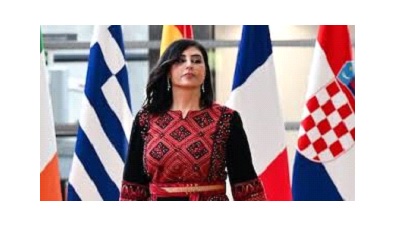

«It’s not only about what is happening to the Palestinians and the genocide that Palestinians have to endure, but about the EU actually respecting its own commitments,» said Palestine’s ambassador to the bloc, Amal Jadou.
«If it really is satisfactory for leaders to go home and enjoy vacations while a nation is being killed and massacred, I think that we have a real issue with our humanity.»
Gaza will be high on the agenda at Tuesday’s gathering in Brussels, the last formal meeting before a summer break. Nearly a week has passed since the EU’s foreign affairs chief, Kaja Kallas, struck a deal with Israel to allow more aid into the embattled enclave.
The deal came after her services circulated an eight-page document that found that Israel had breached its human rights obligations in Gaza, following a request for a review of relations with Israel by a majority of EU countries. They had expressed concern over Israel’s months-long aid blockade and breach of a ceasefire agreed with Hamas in March.
A few days later, Kallas then launched discussions with Israel was to allow more aid into Gaza, adding that that if that was achieved, no action would be taken against Israel. The agreement struck last week laid out Israeli promises of a «substantial increase» in aid lorries delivering food and other supplies, in addition to opening more border crossing points.
This was supposed to have been introduced «within days» but more than 30 Gazans were killed by Israel on Sunday as they were collecting aid, bringing the total number of dead in Gaza to nearly 58,400. «We don’t see enough improvement on the ground,» said Kallas.
The lack of a clear timetable is a worrying signal, Jadou said. «We welcome any agreement that allows the basic needs of Gazans to be met,» she said. «But it really depends on Israel abiding by this agreement and we have seen it break many agreements in the past.»
There can be no role for the Gaza Humanitarian Foundation (GHF), she added, and the UN must be reinstated as the main aid distributor.
The agreement announced by Kallas made no reference to the GHF, despite most EU members voicing their displeasure at the UN being sidelined and the high death rate associated with the GHF’s distribution activities.
Nearly 800 people have been killed by the Israeli army in the vicinity of distribution hubs or on the route of aid convoys since late May, the UN says – a figure rejected by the GHF and Israel. Israel also rejects the use of the word «genocide», increasingly used by human rights organisations and countries such as Ireland.
The EU’s inertia on Gaza is fuelled by its own divisions, with a number of nations, including Germany, refusing to appear critical of Israel because of the country’s historic role in the Second World War.
This has led some countries to make decisions at national level, such as Ireland’s recent move towards complying with an advisory opinion by the International Court of Justice to stop trading with occupied territories.
Last month, nine countries, led by Belgium, asked the European Commission to analyse the impact of the year-old ICJ’s decision on the common market. In a letter to Kallas, they pointed out that there had been no follow-up after a statement by the EU Commission issued in January saying it would do so.
«This discrepancy, in my opinion, will impact the way the international community perceives the EU and its standing, especially in its geopolitical relations with the [Global] South,» Jadou said. «We see that when there are other conflicts in Europe, the EU takes a very strong stance. But when the conflict is outside Europe, then the EU hesitates to take strong steps.»
At the same time, the EU is the biggest financial contributor to the Palestinian Authority, with a €1.6 billion ($1.75 billion) package announced in April. It views the organisation as the only viable option to replace Hamas rule in Gaza though it has called for governing reforms.
«We’re grateful to the EU for taking such a step,» Jadou said. «I also think that the EU should not restrict itself to a financial role but to a more active political role in line with international law, and with its values and principles.»
Yet another issue that will be raised by Shahin in Brussels will be the blockage of taxes collected by Israel on behalf of the PA by Israel’s far-right Finance minister Bezalel Smotrich.
She added that she hoped more European countries would recognise Palestinian statehood, as France and Saudi Arabia prepare to co-chair a UN conference on the two-state solution. So far, 11 EU countries have recognised Palestine.
European diplomats welcomed last week’s deal and said that while they would look closely at its implementation by Israel, it was unlikely that any further decisions would be made on Tuesday. Kallas had also circulated a paper outlining 10 possible retaliatory options to Israel’s human rights breaches.
They included a full suspension of relations, which necessitates an unlikely consensus from the EU’s 27 countries. Decisions based on a qualified majority vote, such as suspending preferential trade relations, Israel’s participation in the Erasmus+ student exchange or Horizon academic research programmes, were also listed.
Jadou said that while she backed a full suspension of the EU-Israel Association Agreement, she understood this was impossible because it would be vetoed by a number of member states. But other options outlined in Kallas option paper should remain on the table. «Why should the EU be complicit in the crimes that Israel is committing?» Ms Jadou said.
Speaking ahead of the meeting, a senior EU diplomat said the options paper would be discussed, but declined to elaborate on further steps. «Whether the discussion on Tuesday will lead to concrete decision on specific measures, I don’t know,» he said.