

By Shawn Musgrave
The arrest of Rümeysa Öztürk over an op-ed that she co-wrote for the Tufts University campus paper proved that student journalists are at risk, especially foreign writers who dared criticize Israel’s war on Gaza.
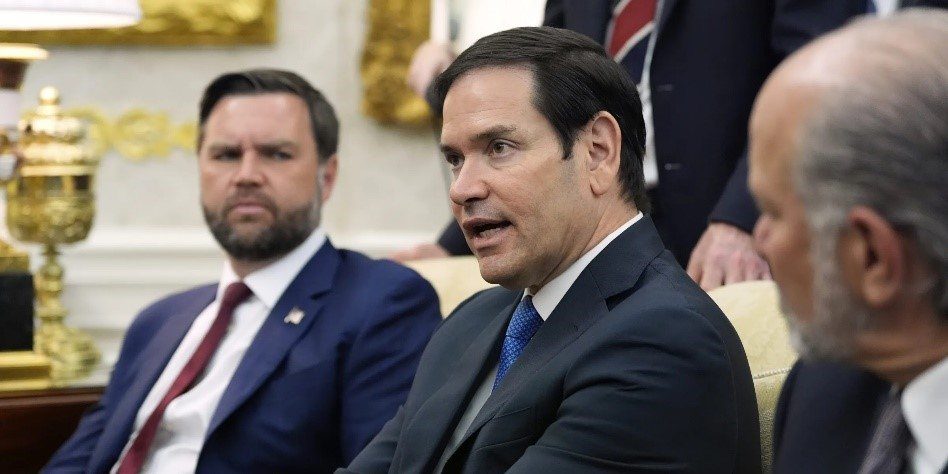
But one student newspaper is fighting back. The Stanford Daily -the independent publication covering Stanford University- filed a First Amendment lawsuit suing Secretary of State Marco Rubio and Secretary of Homeland Security Kristi Noem earlier this month over two tactics they’ve used in targeted deportation cases.
“What’s at stake in this case is whether, when you’re in the United States, you’re free to voice an opinion critical of the government without fear of retaliation,” said Conor Fitzpatrick, an attorney with the Foundation for Individual Rights and Expression, or FIRE, a civil liberties group representing the plaintiffs.
“It does not matter if you’re a citizen, here on a green card, or visiting Las Vegas for the weekend -you shouldn’t have to fear retaliation because the government doesn’t like what you have to say,” Fitzpatrick said.
Over three decades helping student reporters navigate censorship and First Amendment issues, Hiestand had never fielded so many calls focused on potential immigration consequences for coverage on campus, both for the journalists and their named sources.
Öztürk’s arrest just a couple weeks later sent the legal hotline “into overdrive,” Hiestand told The Intercept. He heard from reporters, editors, and even political cartoonists worried their work about Israel, Palestine, and student protests might make them targets too.
In early April, the Student Press Law Center put out an unprecedented alert with other student journalism organizations, which advised campus publications to consider taking down or revising “certain stories that may now be targeted by immigration officials.”
“ICE has weaponized lawful speech and digital footprints and has forced us all to reconsider long-standing journalism norms,” reads the alert.
The next week, the Stanford Daily editors ran a letter about the chill its own staff was facing on campus.
“Both students and faculty have been increasingly hesitant to speak to The Daily and increasingly worried about comments that have already been made on the record,” their letter read. “Some reporters have been choosing to step away from stories in order to keep their name detached from topics that might draw unwanted attention. Even authors of dated opinion pieces have expressed fear that their words might retroactively put them in danger.”
Following the editors’ letter, FIRE approached the Stanford Daily’s editors to sue the Trump administration. It’s not the first time the publication has fought for freedom of the press in court. In 1978, a case brought by the Stanford Daily over a search warrant targeting its newsroom reached the Supreme Court, which ruled 5-3 that the warrant was valid and did not violate the First Amendment.
The student newspaper’s current suit -filed with two individual plaintiffs suing under the pseudonyms Jane Doe and John Doe- challenges two broad, arcane legal provisions that have become Rubio’s go-to tools against student activists and campus critics of Israel’s war on Gaza.
The first provision, which was added to the country’s immigration code in 1990, grants the secretary of state sweeping authority to render noncitizens deportable if they “compromise a compelling United States foreign policy interest.” The second law is even broader, allowing the secretary to revoke visas “at any time, in his discretion.”
There are relatively few cases in which either statute has been the grounds for deportation, particularly compared to the tens of thousands of undocumented immigrants that Immigration and Customs Enforcement has rounded up and detained since Trump returned to the White House.
In fact, immigration scholars found that invoking the foreign policy provision as the sole grounds for deportation was “almost unprecedented,” according to a brief submitted in Khalil’s ongoing court battle by more than 150 lawyers and law professors.
Based on government data, the scholars identified just 15 cases in which the foreign policy provision has ever been invoked, and just four in the past 25 years -most recently in 2018, during the first Trump administration.
“At a minimum, the government’s assertion of authority here is extraordinary -indeed, vanishingly rare,” the scholars wrote in their brief.
In Khalil’s case, the government identified only two others beside Khalil who had been targeted by Rubio under the “foreign policy” provision: although not identified by name, descriptions of the cases match Rubio’s orders against Mohsen Mahdawi, a Palestinian student at Columbia University, and Badar Khan Suri, a scholar at Georgetown University. Oddly, the government failed to mention the case of Yunseo Chung, another Columbia undergraduate with a green card, whose deportation Rubio authorized in the very same letter as for Khalil.
The State Department greenlighted Öztürk’s detention, meanwhile, under the second, broader provision, court records show. The government has not made any similar accounting of how many times Rubio and his staff have invoked his “discretion” to revoke visas over alleged antisemitism.
At one point Rubio claimed to have revoked as many as 300 visas, without specifying the authority under which he did so.
“The chill is the point,” Fitzpatrick, the FIRE attorney, said. “It doesn’t take deporting thousands of noncitizens to accomplish that chill,” since no one wants to become “the next Mahmoud Khalil or Rümeysa Öztürk.”